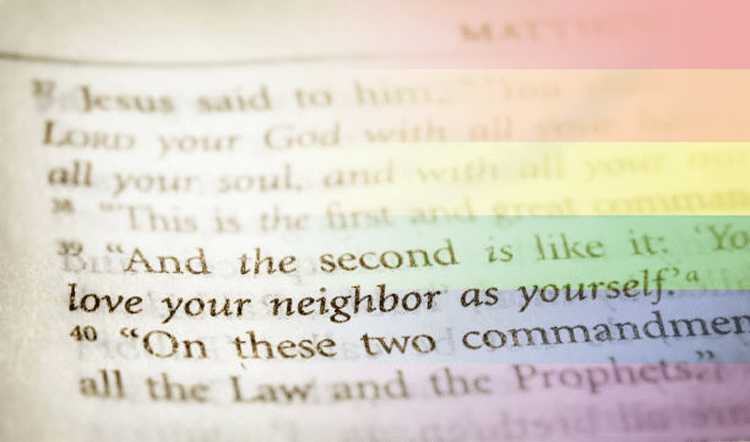
One of the rallying cries of progressive Christianity is that loving our neighbors necessitates accepting homosexuality as a moral good. The kind of remarks used to justify this position are “Jesus has called us to love all of our neighbors and all means all” or “love is love.” Though is that true? The following article will demonstrate that these sort of statements are not only false but harmful to those suffering from same-sex attraction.
Most people by now at least know that a cursory reading of Scripture clearly condemns homosexuality as a sin in both the Old and the New Testaments. A straightforward reading of the texts makes it obvious that God has forbidden such unions. While advocates for gay marriage claim that conservatives use clobber passages to stress the prohibition of homosexual unions, the reality is that the Church has historically held that same-sex relationships are sinful because the doctrine is so obvious and pervasive in Scripture.
It is no accident that the condemnation of this sin is sandwiched within a list of other sins. For example, in Leviticus 18:22 the condemnation of homosexuality is positioned after idolatrous murder and before bestiality. Then again in 1 Corinthians 6:9-10 and 1 Timothy 1:8-11 homosexuality is positioned between a slew of other sins. To claim that homosexuality is rarely mentioned and without force suggests that the other sins in the levitical law and Pauline letters are of little significance. One cannot have it both ways. Either all the moral sins mentioned are forbidden or none of them are.
Further, to claim that such prohibitions are so-called clobber passages makes little sense considering more is said about homosexuality than a bevy of other positions that the Church holds despite scant Scriptural evidence.
So it is clear that God has has prohibited same-sex marriages and for good reason. The truth of the matter is that the Lord sets up boundaries for our own well-being, and when we step over those boundaries we only suffer.
First and foremost if people live in unrepentant sin they experience alienation from the Lord that only grows wider and wider with time, which can ultimately lead to eternal anguish if left unchecked. To be sure, sin begets sin and creates a viscous cycle and a downward spiral. While it is true that only Jesus can save people, the more someone puts distance between themselves and Jesus the more they forgo the grace they need to sustain a holy and loving relationship with God. If left unchecked, like any other sin, it can lead to eternal consequences (1 Cor. 6:9).
Not only that but there are real practical ramifications for crossing over boundaries that God has set in place. When someone lies they jeopardize their relationships with others that are built on trust. When someone covets they nurture an inward greed that festers until a breaking point is reached which in turn compels them to act out in sin. The same is true with homosexuality. When people engage in same-sex relationships they ultimately suffer real life consequences.
The reality is that scientific studies have shown that those in same-sex relationships are at high risk of suffering. It is true that there are some recent studies that argue the contrary but it must be kept in mind that activists have infiltrated the sciences and often do not conduct studies with integrity. Studies on homosexuality are the only kinds of studies that have been allowed to the circumvent the rigors of science without much objection. Many of these studies do not meet the criteria for authentic scientific inquiry because they are not (1) long-term studies or (2) conducted with random samples or (3) employ a bevy of samples.
One such study that was celebrated even though it did not pass muster was Evelyn Hooker’s study published in 1957.1 In this study Hooker took 30 homosexuals and 30 heterosexuals and then matched them based on their age, education, and IQ. Once the study was complete she concluded that homosexual relationships were just as healthy and thriving as their heterosexual counterparts. The result was widespread acceptance of these results which demonstrates that people will accept anything that they desperately want to be true.
The problem with Hooker’s study is that she not only hand selected the participants but used an incredibly small sampling size for a study that merely lasted a year. Further, the project was supported by the Mattachine Society which is an organization that actively pursues integrating homosexuals into society, which shows a clear bias. With these kind of metrics it is shocking that her study was so easily accepted and adopted into the field of psychology and used to promulgate the idea that homosexuality is natural and healthy, especially in light of contradictory studies.
When such studies actually meet the proper criteria the results are quite different and astonishing2. Consider a large systematic review of studies that was conducted between January 1966 to April 2005.3 In this particular review there were 214,344 heterosexuals and 11,971 homosexuals who were studied. The review concluded the following:
In summary, there was an increased lifetime and 12 month risk of alcohol and drug dependency in all groups compared with heterosexuals with markedly higher risk in lesbian and bisexual women. LBG people are at higher risk of suicidal behavior, mental disorder and substance misuse and dependence than heterosexual people. The results of the meta-analyses demonstrates a two-fold excess in risk of suicide attempts in the preceding year in men and women, and a four-fold excess risk in gay and bisexual men over a lifetime. Similarly, depression, anxiety, alcohol and substance misuse were at least 1.5 times more common in LGB people. Findings were similar in men and women but LG women were at particular risk of substance dependence, while lifetime risk of suicide attempts was especially high in GB men.
To appeal to another study consider one that was published in 1999 that was conducted over the course of 21 years.4 The participants in this study were 1,265 children in New Zealand. The study questioned the participants once they reached age 21 about their sexual orientation and relationships with same-sex partners since the time that they were 16 years old. Here are the findings:
Over the period from age 14 to 21 years, data was gathered on a range of psychiatric disorders that included major depression, generalized anxiety disorder, conduct disorder, and substance use disorders. Data were also gathered on suicidal ideation and suicide attempts… Findings support recent evidence suggesting that gay, lesbian and bisexual young people are at increased risk of mental health problems, with these associations being particularly evident for measures of suicidal behavior and multiple disorder.
Other studies from the same authors show that among gay and bisexual men the risk of suicide is no less than 14 times higher than heterosexuals. In the final analysis the collective studies on this subject show the following negative consequences of active homosexuals which far surpass that of heterosexuals:
- Lesbian couples have the highest rate of domestic violence
- Alcohol and drug dependency
- Depression
- Anxiety
- Psychiatric disorders
- Physical health disorders
- Sexually transmitted diseases
- Suicidal behavior (four to fourteen times higher than heterosexuals)
- Suicidal attempts
- Lower life expectancy of 8-20 years
The consequences of homosexual behavior also negatively impacts children. In a June 2011 study5 carried out by the Centers for Disease Control and Prevention (CDC) the results found that homosexual children in grades 9-12 suffered by the following effects:
- Gay and lesbian students considered suicide at a median of 29.6% compared to heterosexuals at a median of 11.7%, and bisexual students at a median of 40.3%
- Gay and lesbian students attempted suicide at a median of 25.8% compared to heterosexuals at a median of 6.4%, and bisexual students at a median of 28%
- Gay and lesbian students had sexual intercourse before age 13 at a median of 19.8% compared to heterosexual students at a median of 4.8%, and bisexual students at a median of 14.6%.
- Gay and lesbian students had sexual intercourse with four or more persons during their life at a median of 29.9% compared to heterosexual students at a median of 11.1%, and bisexual students at a median of 28.2%.
- Gay and lesbian students that reported that they were sexually active had a median of 53.2% compared to heterosexual students at a median of 32%, and bisexual students at a median of 52.6%.
The obvious conclusion is that these children are suffering more than their heterosexual counterparts. To be sure much work must be done on both fronts, but it cannot be denied that gay, lesbian, and bisexual students are at a higher risk of suffering.
The expected rebuttal to these studies tends to be that homosexuality is not the cause of their suffering because it has to do with the environment in which they find themselves. In other words, the cause of their suffering is due to discrimination. Yet again studies have made this claim more than dubious.
Take for example a large Dutch study that was published in 2006 boasting around 10,000 participants.6 In this study the participants were responsible for self-reporting any physical or mental health problems. The result was that the homosexual population reported far more prevalence towards physical and mental health problems.
What makes this study so significant is that the Dutch are among the most inclusive and tolerant people in the world and are years ahead of other countries when it comes to societal acceptance of homosexuality. One would therefore expect a divergence in the results of the study but instead the data shows that homosexuals experience the same negative consequences in all-inclusive environments that they do in other parts of the world, strongly suggesting that environment cannot account for the brunt of suffering among the LGBTQ+ community.
Another consideration regarding the negative consequences of homosexuality is the impact such relationships have on children. Today many same-sex couples are adopting children which seems noble at first glance but must be scrutinized for the sake of children. In July 2012 an article7 was published by Dr. Mark Regnerus of the University of Texas at Austin that demonstrated that children in same-sex households do not have the best opportunity for a healthy and thriving upbringing.
The study compared 40 different social, emotional, and relational outcomes and analyzed the impact on children who lived with heterosexual parents and those who lived with homosexual parents. Here is what Dr. Mark Regnerus concluded:
Small sample sizes can contribute to ‘no difference’ conclusions. It is not surprising that statistically significant differences would not emerge in studies employing as few as 18 or 33 or 44 cases of respondents with same-sex parents respectively… But the NFSS also clearly reveals that children appear most apt to succeed well as adults–on multiple counts and across a variety of domains–when they spend their entire childhood with their married mother and father, and especially when the parents remain married to the present day.
When Dr. Regnerus published his findings he was met with criticism and ridicule because the results of his study did not justify the prevailing narrative that the sexual orientation of parents makes no difference in the well-being of children. He subsequently published a response:
Perhaps in social reality there are really two ‘gold standards’ of family stability and context for children’s flourishing–a heterosexual stably-coupled household and the same among gay/lesbian households–but no population-based sample analyses is yet able to consistently confirm wide evidence of the latter.
Other studies have confirmed Dr. Regnerus’s conclusion but due to the highly aggressive LGBTQ+ lobby fueled by emotionally charged convictions, such studies are met with hostility instead of neutral scientific scrutiny.
With all that has been said it is important to address the assertion that unless Christians embrace and accept homosexuality as a moral good they are not in fact loving their neighbors. It should be obvious by now that such a position is untenable. Of course it is possible to find exceptions to the rule practically speaking, but even so such behavior cannot escape the scorn of God nor can it speak to the whole. Thus accepting homosexuality as a moral good and even turning a blind eye to such relationships is the opposite of loving our neighbors.
Consider this example. Let us say that I have a friend who is struggling with an addiction to drugs who has no desire to seek help or change. Now let us say that I tell this friend that although he identifies as a drug addict that he has my undying support. Not only that but I then continue to inform him that I will fight for his right to use drugs because there is nothing wrong with it as long as it makes him happy and gives him identity and purpose.
Would that be loving? Is that the kind of righteous love that God calls me to have for my neighbor? No. There is nothing of love in such an attitude towards those who are suffering. Instead of adopting a live and let live attitude I am called to help my friend confront his struggle in a loving way and then walk with him through any hardship he faces until he finds peace within himself and God.
Unfortunately too many Christians would rather be like a parent who seeks to be their children’s best friend instead of actually parenting their children in a firm and loving way. Though I can assure you that such an attitude is the furthest thing from loving a neighbor. In some ways it is a self-serving love that excuses people from difficult and messy conversations, but only at the expense of the suffering homosexual.
These attacks that accuse conservatives as being judgmental and hateful are usually unwarranted and devoid of substance. Such an attack is merely a straw man fallacy employed to dismiss traditional positions while giving the accuser the impression that they are morally superior to so-called unloving Christians. It is not a contradiction to love someone who is gay while nurturing them to have a better understanding of God’s will for their lives and helping them along the way.
The reality is that some Christians believe they are fighting for a good cause but are merely adopting the moral landscape of the world which always leads to sin and ends in suffering. People do not get to define love on their own terms, so no matter how loud and often someone shouts the mantra “love is love” it does not make it true. There is a difference between a holy and righteous love ordained by God and a worldly counterfeit love parading around as something that it is not.
It is no mistake that progressive Christianity is striving to accept homosexuality as a moral good at the same time that the secular world is putting tremendous pressure on society and the Church. You would think that if homosexuality was in fact something divinely ordained by God that the Church would have spearheaded this movement many, many years ago instead of simply jumping on the bandwagon years after secularists have made tremendous strides.
As Christians we have a moral responsibility to help people confront their sin that is causing them pain and suffering. We do this regarding any sin and cannot make homosexuality an exception or single it out. If we truly want to love our neighbors then we need to walk with our homosexual friends and help them find a place of peace with the Lord and bear their pain with them as disciples of Jesus Christ. No doubt that the road will be arduous but where there is grace there is hope, and we serve a God of unlimited grace who generously lavishes it upon those who repent and seek His face.
- Hooker, E. (1957). The Adjustment of the Male Overt Homosexual. Journal of Projective Techniques, 21(1), 18–31. https://doi.org/10.1080/08853126.1957.10380742 ↩︎
- I owe much to the research of Dr. Norman Geisler and Doug Van Gordan: Geisler, Norman L., and Doug Van Gordon. Somewhere under the rainbow: A Christian look at same-sex “marriage.” Matthews, NC: Bastion Books, 2017, 78-87. ↩︎
- King M, Semlyen J, Tai SS, Killaspy H, Osborn D, Popelyuk D, Nazareth I. A systematic review of mental disorder, suicide, and deliberate self harm in lesbian, gay and bisexual people. BMC Psychiatry. 2008 Aug 18;8:70. doi: 10.1186/1471-244X-8-70. PMID: 18706118; PMCID: PMC2533652. ↩︎
- Fergusson DM, Horwood LJ, Beautrais AL. Is sexual orientation related to mental health problems and suicidality in young people? Arch Gen Psychiatry. 1999 Oct;56(10):876-80. doi: 10.1001/archpsyc.56.10.876. PMID: 10530626. ↩︎
- Kann L, Olsen EO, McManus T, Kinchen S, Chyen D, Harris WA, Wechsler H; Centers for Disease Control and Prevention (CDC). Sexual identity, sex of sexual contacts, and health-risk behaviors among students in grades 9-12–youth risk behavior surveillance, selected sites, United States, 2001-2009. MMWR Surveill Summ. 2011 Jun 10;60(7):1-133. PMID: 21659985. ↩︎
- Sandfort TG, Bakker F, Schellevis FG, Vanwesenbeeck I. Sexual orientation and mental and physical health status: findings from a Dutch population survey. Am J Public Health. 2006 Jun;96(6):1119-25. doi: 10.2105/AJPH.2004.058891. Epub 2006 May 2. PMID: 16670235; PMCID: PMC1470639. ↩︎
- Regnerus M. How different are the adult children of parents who have same-sex relationships? Findings from the New Family Structures Study. Soc Sci Res. 2012 Jul;41(4):752-70. doi: 10.1016/j.ssresearch.2012.03.009. PMID: 23017845. ↩︎








Leave a Reply